


Wagner Group commander Yevgeny Prigozhin recently brought an abrupt end to his troops’ mutinous march on Moscow, marking the conclusion of a startling rebellion that posed a significant threat to Russian President Vladimir Putin’s authoritarian rule. The coup attempt, led by the 25,000-member strong mercenary army, which had been fighting alongside Russian soldiers in Ukraine, lasted a mere 20 hours but sent shockwaves worldwide. But how did this fold in? What led the Wagner group to choose the path of going against the Russian Defence ministry?
Russia’s History with Mercenaries
Historically, the Russian authorities strongly opposed the existence of armed formations outside the official Armed Forces and law enforcement agencies. Private military companies (PMCs) were considered illegal, and engaging in mercenary activities was a criminal offense. However, the emergence of the “Gerasimov doctrine” in 2013, which emphasized the blurred lines between war and peace, prompted the Russian leadership to consider the use of PMCs. The Kremlin envisioned PMCs as ideal instruments for covert operations, allowing deniability and avoiding direct responsibility for military engagements.
Following the annexation of Crimea in 2014, the Russian military leadership realized that repeating the operation in Donbass would be challenging due to the extensive deployment of troops required to secure the new territories. To overcome this challenge, Yevgeny Prigozhin, a businessman known for his close ties to the Kremlin, established the Wagner Group. Named after the German composer Richard Wagner, the group was officially registered as a private military company in Russia. Wagner quickly gained attention for its involvement in the conflicts in eastern Ukraine and Syria.
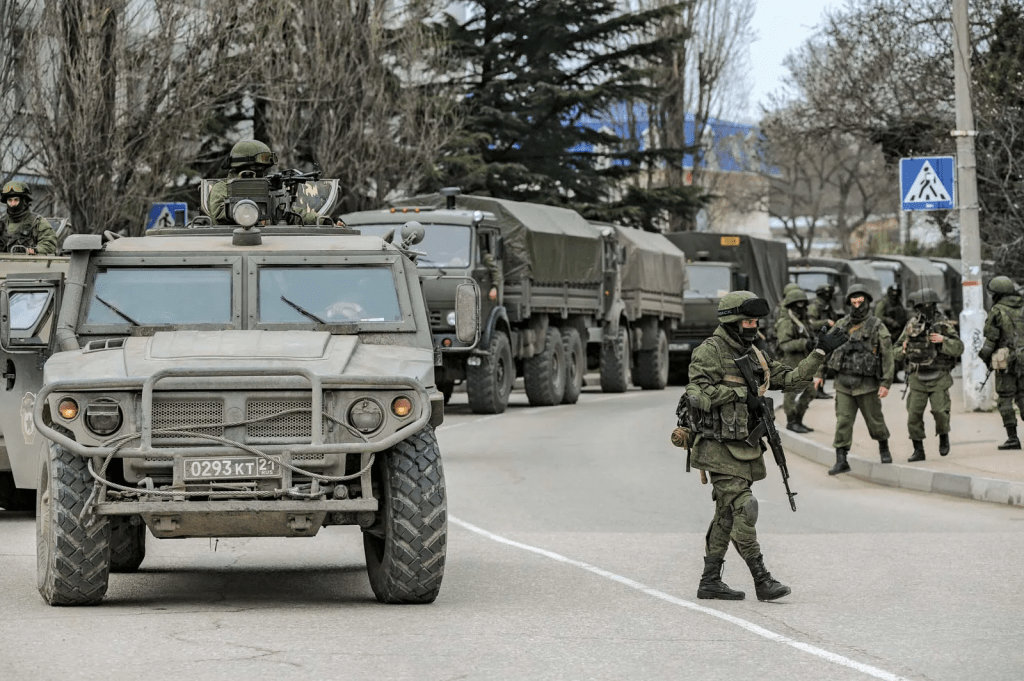
The Wagner Group operates as a quasi-mercenary force, employing a mix of ex-military personnel and volunteers. While the exact size of the group is unknown, estimates range from 25K to 50K strong men. Wagner’s fighters are often drawn from the ranks of Russian military veterans and unemployed individuals seeking lucrative opportunities. The group’s appeal lies in the promise of financial compensation, combat experience, and the opportunity to participate in clandestine operations with the backing of the Russian state.
Wagner’s operations have been shrouded in secrecy, with the Russian government officially denying any connection to the group. However, numerous reports and investigations have revealed close ties between Wagner and the Russian state, including the provision of equipment, training, and coordination with regular military forces. Wagner’s fighters have been observed using Russian military equipment and tactics, further suggesting a link to the state.The existence of a private military formation with substantial firepower and influence undermines the centralized control and discipline that is crucial for an effective military. The loyalty of Wagner’s fighters to Prigozhin and their willingness to openly challenge the regular Armed Forces raises questions about the cohesion and unity within the Russian military.

Prigozhin’s criticism primarily targets Defense Minister Sergei Shoigu and Chief of General Staff Valery Gerasimov for allegedly neglecting to supply Wagner with the necessary ammunition. He accuses the Ministry of Defense of losing advantageous positions during the intense fighting against the Ukrainian army near Bakhmut. Prigozhin’s scathing remarks even extend to President Putin, although veiled, suggesting dissatisfaction with his leadership. Additionally, leaked information from the CIA claims that Prigozhin has been in contact with Ukrainian military intelligence, offering to provide data on Russian military deployments in exchange for surrendering Bakhmut.
Moreover, Prigozhin takes a clear political stance by emphasizing social inequality during the war, pointing out that ordinary people bear the brunt of the hardships while the elite, including the defense minister’s relatives, enjoy luxury. He highlights the failure to achieve the war’s declared goals and argues that the course of the conflict has inadvertently strengthened Ukraine’s nation-building efforts and military capabilities. Despite having thousands of armed men at his disposal, Prigozhin admits that his lack of sufficient military might prevents him from taking further action.

On 24th June In a message on Telegram, Prigozhin announced that his troops would be turning back and returning to their field camps in eastern Ukraine, where they were previously engaged in combat. He revealed that they had come within 200 kilometers of Moscow within 24 hours, emphasizing that no casualties had occurred among his fighters up to that point. However, he warned that the situation could escalate and result in bloodshed. The resolution of the crisis came through a deal brokered by President Alexander Lukashenko of Belarus. As per the agreement, Russia will not pursue criminal charges against Prigozhin, but the Wagner Group leader will relocate to Belarus instead of returning to the fighting in Ukraine. The question now is what this aborted revolt means for the loyalty of Russia’s ill-trained and demoralized regular forces, as well as for the notoriously complacent Russian population, the rattled oligarchs, and already disenchanted national leaders from China to Chechnya. The specter of “loose nukes” is another unspeakable implication of a Russian civil war with unclear control of strategic weapons.

However, there’s another theory floating in which is important to address as well.Vladimir Putin’s political acumen and strategic maneuvering have once again come to the forefront in the events surrounding Wagner’s Private Military Company (PMC). By closely examining the relationship between Putin and his trusted ally Yevgeny Prigozhin, as well as the decision to relocate to Belarus, we can unravel the hidden motives and potential implications of this calculated move.
Yevgeny Prigozhin’s close friendship with Putin since 2001 establishes him as one of the President’s most trusted confidants. Their enduring bond suggests a level of trust and cooperation that provides a solid foundation for joint ventures and collaborative efforts. In a carefully orchestrated move against the Russian military and Putin, a staged ‘coup’ unfolded. As a result, a truce was signed, and the chief of Wagner PMC is now slated to relocate to Belarus. This decision holds significant implications due to Belarus’s strategic geographical position. By moving to Belarus, Prigozhin positions himself in close proximity to Ukraine, a region of great geopolitical importance. This relocation opens up an opportunity for Prigozhin to lead a group of mercenaries from Belarus into Ukraine without officially involving Belarus itself. The covert nature of this operation could catch the Ukrainian defense forces off guard, allowing them to bypass established defenses effectively.
It is crucial to acknowledge the robust alliance between Russia and Belarus, which has persevered despite the ongoing conflict in Ukraine. Russia provides substantial assistance to Belarus in the form of financial aid, preferential gas prices, and collaborative projects. This close partnership strengthens their ties and sets the stage for coordinated actions. The relocation of Prigozhin and his group to Belarus suggests that Putin’s strategy aims to escalate the Russia-Ukraine conflict further. Putin, renowned for his ability to establish a strong foothold, seeks to consolidate Russia’s position and exert greater influence in the region through this calculated move.
 vision of sid
So the two might have played to the gallery? Not at all impossible, to the contrary!
Again a very interesting article, Sid!
LikeLike